← Back to Axial Seamount Earthquake Catalog
by Maochuan Zhang
Page last updated: 16-Mar-2026 13:05:59 UTC
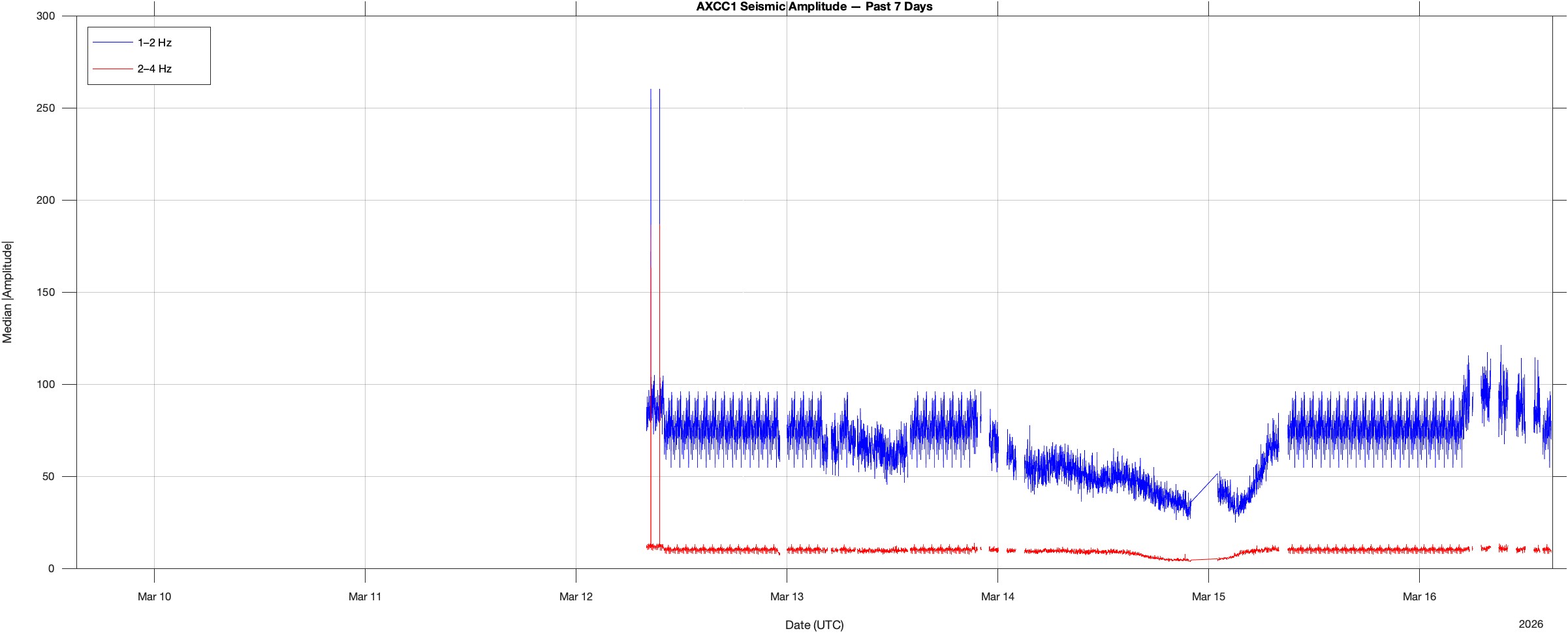
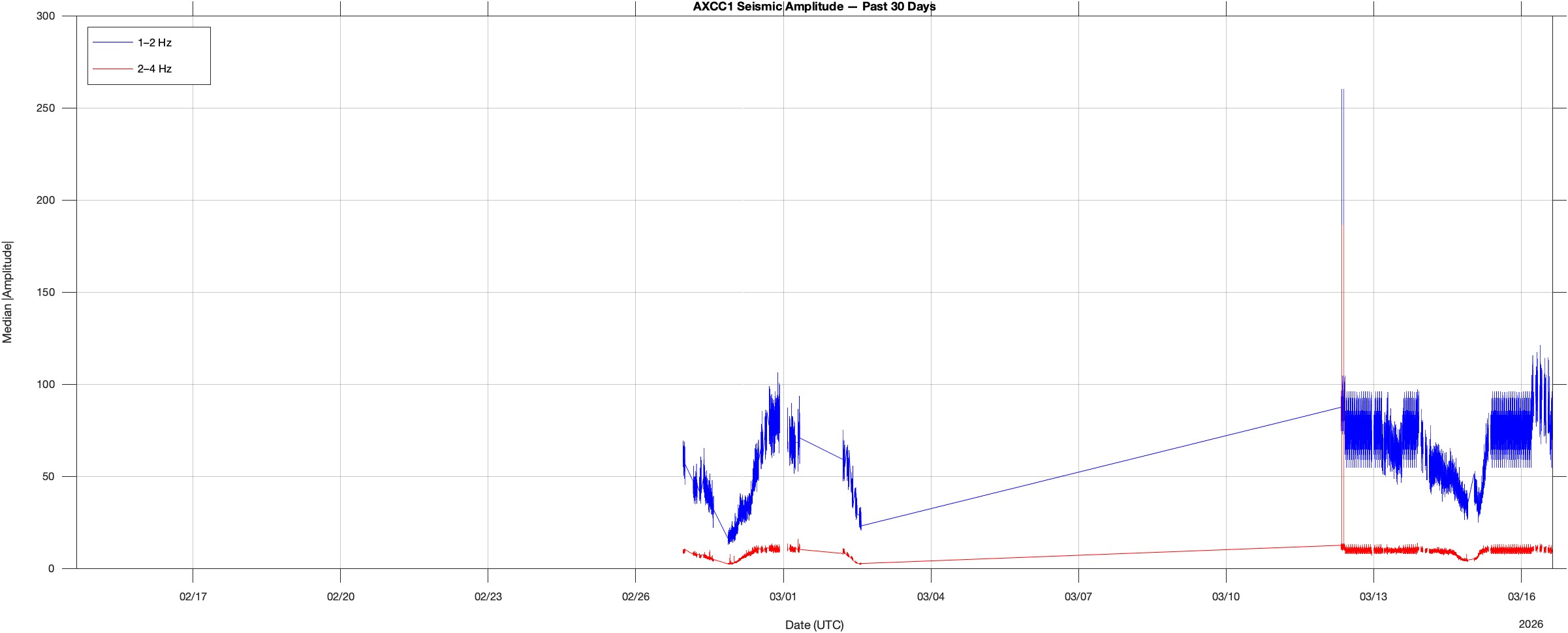
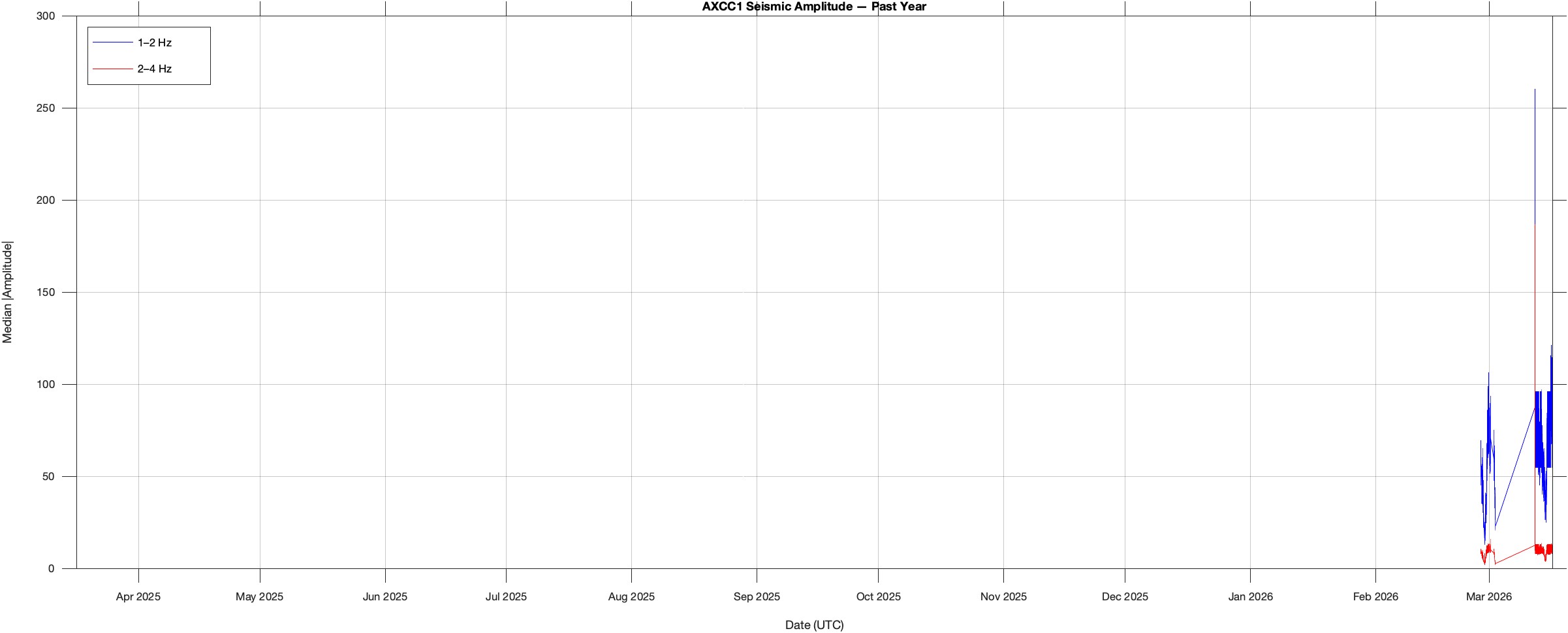
Continuous Amplitude Seismic Monitoring (CASM) — also known as Real-time Seismic Amplitude Measurement (RSAM) — tracks the median absolute amplitude of seismic waveforms at station AXCC1 (Central Caldera) in two frequency bands: 1–2 Hz (blue) and 2–4 Hz (red). Both bands are overlaid on a single figure for direct comparison.
Data resolution: The full-history and long-window plots combine two data sources: a historical archive (2015–present, 1 value per hour) computed by batch processing of downloaded waveforms from IRIS DMC, and a near-real-time stream (1 value per minute) updated hourly. Recent data therefore appears at 60× finer temporal resolution than the historical record.
Current data source: 200 Hz broadband data (HHZ channel), filtered 1–2 Hz and 2–4 Hz.
Historical archive at 1-hour resolution combined with near-real-time data at 1-minute resolution.
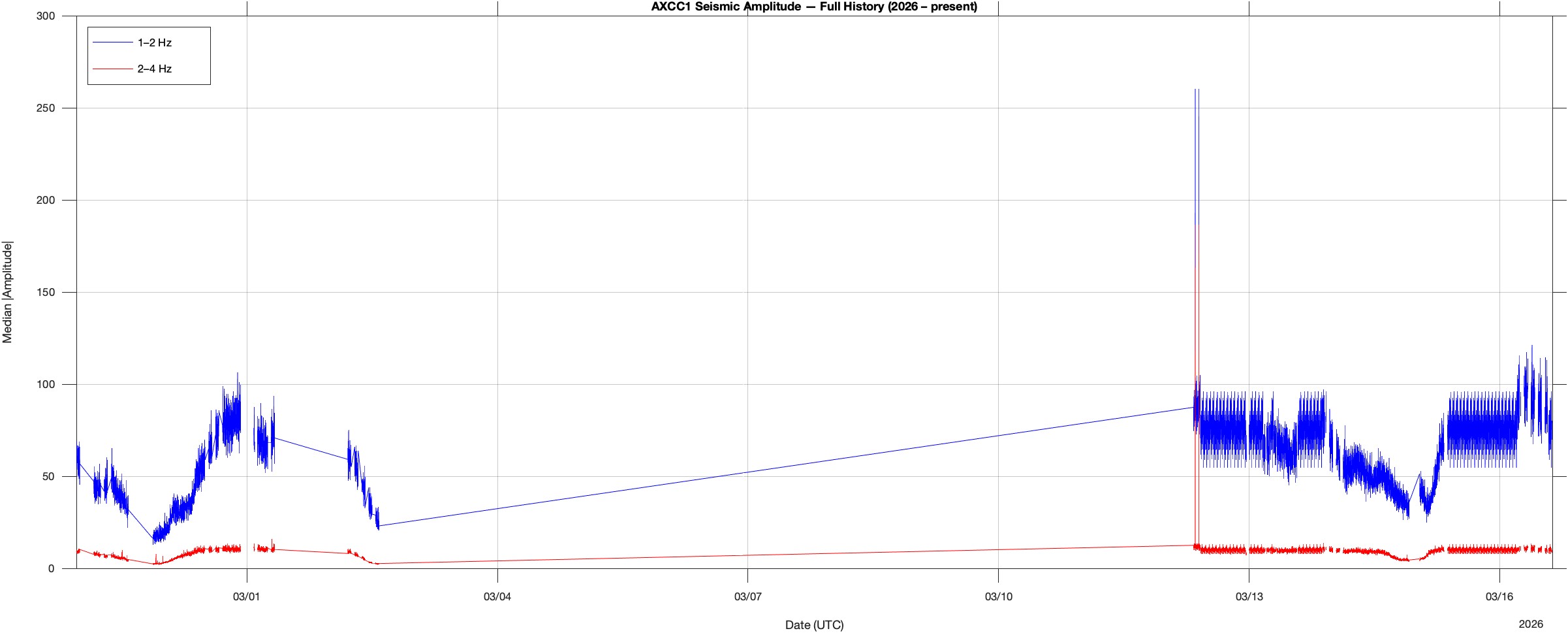
Each figure shows the median absolute amplitude of vertical ground motion at AXCC1 (Central Caldera), with the 1–2 Hz band (blue) and 2–4 Hz band (red) overlaid on the same axes. Amplitudes are in raw counts (not normalized), so the y-axis scale is consistent across time windows — making it possible to compare absolute activity levels.
Elevated amplitudes indicate increased seismic activity. Simultaneous increases in both bands are characteristic of earthquake swarms. In the full-history plot, the transition from coarser (hourly) to finer (per-minute) resolution is visible as a change in trace texture near the present day. Sharp short-duration spikes may reflect individual large earthquakes or instrument noise.
Axial Seamount is one of the most seismically active volcanoes on Earth. Background seismicity is continuous, and episodic swarms — particularly in the caldera — can indicate magmatic activity or fault slip. The 2015 eruption was preceded by a sharp increase in CASM amplitude across caldera stations in the hours before the eruption onset.
OOI Cabled Array seafloor stations used: AXCC1 (Central Caldera), AXEC1, AXEC2, AXEC3 (East Caldera), AXAS1, AXAS2 (ASH), AXID1 (International District). All are broadband seismometers (OO network) on the Juan de Fuca Ridge at ~1500 m water depth.
The RSAM/CASM method was introduced by:
Endo, E. T., and Murray, T. L. (1991). Real-time Seismic Amplitude Measurement (RSAM): a volcano monitoring tool. Bulletin of Volcanology, 53, 533–545. https://doi.org/10.1007/BF00298154
When using earthquake catalog data from this site, please cite:
Wilcock, W. S. D., M. Tolstoy, F. Waldhauser, C. Garcia, Y. J. Tan, D. R. Bohnenstiehl, J. Caplan-Auerbach, R. P. Dziak, A. Arnulf, & M. E. Mann (2016). Seismic constraints on caldera dynamics from the 2015 Axial Seamount eruption. Science, 354, 1395–1399.